
Marina Papagayo
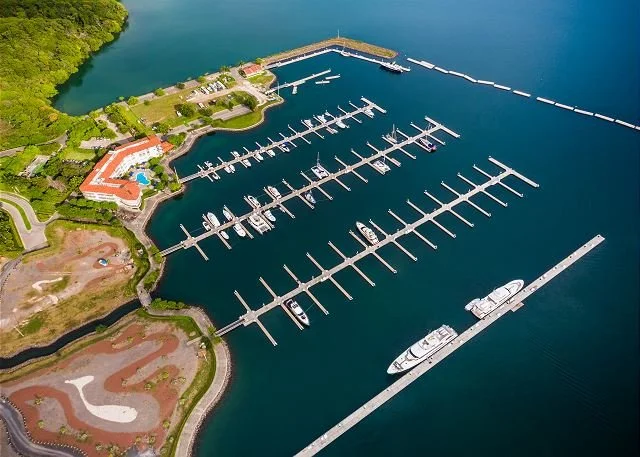
Marina Design and Floating Wave Attenuator Design.
Planning and Engineering for a new luxury marina in Guanacaste, Costa Rica.
Lead Design Engineer / Assistant Project Manager
Client: Shoremaster, Inc.
Project: Marina Papagayo Design-Build
Location: Guanacaste, Costa Rica
Duration: 2007-2010
Project Background
Marina Papagayo is a design-build luxury marina development located in Guanacaste, Costa Rica, developed to accommodate megayachts and high-end recreational vessels within a resort setting. The marina complex includes approximately 5,000 linear feet of berthing infrastructure, with 320 slips ranging from 40 to 80 feet in length, a 250-boat drystack storage facility for vessels up to 40 feet, and a 535-foot fuel dock equipped with 100-gpm dispensers. Marina utilities include 50-amp and 100-amp single-phase and three-phase electrical service and a marina-wide wireless communication system.
Marina Planning and Structural Design
While employed by Tetra Tech, Anthony T. Mets, P.E. served as Lead Design Engineer and Assistant Project Manager for the design-build Marina Papagayo project. Mr. Mets was responsible for the engineering design of floating dock systems serving megayacht and recreational berthing, with design considerations addressing vessel loads, berthing forces, utility demands, and long-term operational performance. The floating dock system utilized a post-tensioned reinforced concrete design selected to enhance structural integrity, durability, and reduced maintenance requirements in a tropical marine environment. Mr. Mets also designed aluminum gangway systems connecting the floating docks to shore, meeting increased live load requirements in accordance with the 2006 International Building Code.
Coastal Engineering and Wave Protection
The marina is protected by two floating wave attenuators with a combined length of approximately 1,350 linear feet. Mr. Mets performed buoyancy, stability, and structural design of the floating dock and wave attenuator systems, as well as a complete wave transmission and performance analyses to evaluate attenuation effectiveness under site-specific wave conditions. Anchor systems for the floating wave attenuators were designed to resist environmental and operational loading demands with a critical requirement to adjust the anchor cable lengths to accommodate the water elevation changes.
This project was performed by Anthony T. Mets, P.E. while employed by another engineering firm. It is included here to illustrate relevant professional experience and does not represent work performed by Thalassa Technology and Engineering.
